The Misunderstood Genius: A Guide to Leveraging AI in the Long Run
Have you ever felt less productive because of AI agents? You jump between five chats, check intermediate results, give feedback, and at the end of the day you’re not quite sure what you actually got done.
Meanwhile you hear what agents already do for you:
- they book you a table
- they answer your email
- they build you a prototype
And you hear what we’re being promised:
- a datacenter full of geniuses
- the first billion-dollar company with a single employee
- research systems that solve open math problems by the dozen
- companies that run fully autonomously and make deals with each other
Do you also feel there’s a gap between these two lists?
I do. And I think the reason is simple. The first list is made of tasks where you sit next to the agent and wait. The second is made of processes that run and scale without you. We use agents for the first and expect the second.
Alex Zhang, Zed Li and Omar Khattab recently argued in their Mismanaged Geniuses Hypothesis that language models are underused because individual model calls are badly managed. I think the genius is also misunderstood one level higher: not in how the model works inside, but in how we work with it.
In this post I want to show you a different way to think about AI: self-driving processes. It gives you a strategic lens on AI progress, and three steps to apply it to your own work.
The intern who finishes work after five minutes
You probably work with AI the way you’d work with a person. You ask questions, delegate research and walk it through tasks. Sometimes you even chat with it like you would with another human.
The usual analogy: treat AI like a very smart intern who doesn’t know your work yet.
That analogy leaves out something important. AI works like a machine, but we treat it like a person. An agent can work around the clock and process more data in a few minutes than a human could in a lifetime.
When you ask it to write a .docx or fix a bug, it works for a few minutes and then waits for you again. You end up working reactively all day, which many people experience as unfocused. And the agent sits idle most of the time.
Imagine you get a new employee. Instead of onboarding them properly once and then letting them work on their own, you tell them: do exactly what I say, nothing more. That’s how most of us work with agents.
Self-driving processes
An example. A researcher uses Claude Code to write emails to his supervisors, think through strategic questions and analyze datasets. It changes how he works. But it doesn’t touch the core of his work.
A researcher is called a researcher because he does research. Research is the process that creates the value (knowledge).
That’s where self-driving processes start: with the process that creates the value of your work, not with the work around it. Automating your inbox saves time. Automating your research changes what you can achieve at all.
In science, this looks like a system that forms hypotheses, plans experiments, evaluates them and remembers what worked and what didn’t. Richard Socher calls such a system a Eureka Machine. Self-driving labs already run this loop today, with robots that carry out the experiments and models that choose the next one.
Most companies don’t run robot labs, but their core work follows the same logic. Product development tests ideas against users. Sales tests offers against the market. In both, you can bring AI in two very different ways:
| Delegating tasks to agents | Handing the process to AI | |
|---|---|---|
| Scope | single, often peripheral tasks | the core of your work |
| What you gain | a few minutes per task | room to design the process itself |
| Scaling | bounded by your attention | highly scalable |
| Your role | you stay inside the work, with less of it | you design and steer the process |
The Shape of AI
If you sketch how we’ve worked with AI so far, one question tells the stages apart: who carries the process?
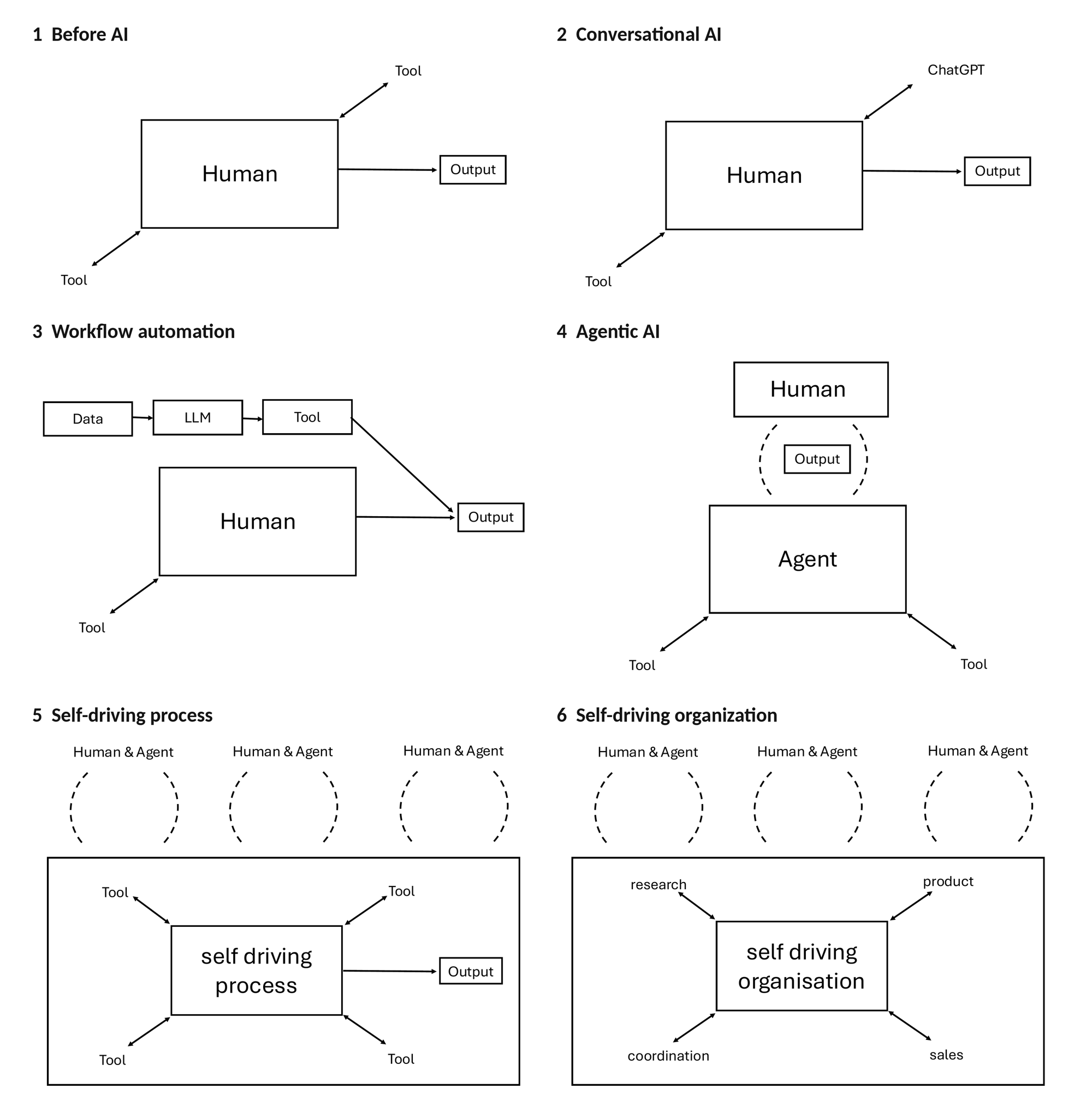
Six stages of working with AI: what sits in the middle moves from the human to the process.
Before AI, a person sat in the middle, surrounded by tools. ChatGPT added one more tool, but the middle stayed the same. Workflow automation put small pipelines next to the person for the first time, running without them. But they’re rigid and only do what someone defined in advance.
With agents, AI itself moves into the middle. The person sits right above it, though: every output passes through their hands before anything continues. The agent is only as fast as the attention you give it.
Self-driving processes are the next step. A process now sits in the middle, producing the core output with its own tools and its own feedback. Humans and agents work on it from the outside: they set goals, add components and check whether the process gets better. Autonomy stops being a goal you chase. It’s a property of a process that was built to run without you. A new production paradigm, much like the assembly line once was.
The last panel shows where this goes. When several self-driving processes grow together, you get a self-driving organization: research, product and sales as one system that pursues goals and manages itself.
A different way to look at work
Once you see self-driving processes, you look at work differently. The question stops being which task an agent can take off your plate. It becomes: where could a process run on its own, and how far could it scale?
Processes nest. Building a spreadsheet is part of a project, a project is part of a function like research or sales, and all functions together are the organization. Most agents today work at the level of the spreadsheet. Self-driving processes take over the project, then the function, and eventually the organization.
How we climb these levels follows a pattern. We build structure around a process so it runs reliably. Better models absorb that structure into their own behavior, and the process runs autonomously. Then we take on the next level, which needs structure again.
Try it on your own work, or on the next AI announcement you read:
- Where is the value created? Not in the tasks around it, but in the process whose output someone pays for.
- Could that process run on its own? What would it need: data, tools, a way to check its own results?
- How far could it scale? If it ran around the clock, a hundred times in parallel, what would that be worth?
Step 1: Find the processes that create value
Start by asking: why does your work exist at all? Which output is the reason someone pays for it? This list helps you sort:
- (market) research
- product development and optimization
- the product itself
- sales
- management
- leadership and strategy
Then look one level above where you use agents today. That’s usually where a self-driving process starts.
Step 2: Pick one
Not every process is an equally good place to start. Three questions help:
- How much value does it create? The more, the better.
- How structured and digital is the work inside it? The more, the better.
- What makes a good output? Clear evidence beats human taste.
Start where your process already gives clear feedback. That’s why the first self-driving processes run in software development and research: a test passes or fails, a metric goes up or down. Where feedback is missing today, you can build it (more on that in step 3).
Processes that look too complex today may not be tomorrow. Complexity isn’t a reason to rule something out, at most a question of time.
The most important process to make self-driving is the product itself. Karpathy calls programs that are written in natural language and run on a language model Software 3.0. Take that one step further and an AI system is no longer a tool you use to build a product. It is the software: a process that produces for every user what a whole product used to deliver. I believe that’s where most value will come from in the long run. Tackling it head-on takes the most courage.
For companies, the bigger lever isn’t an agent for every employee. It’s employees who build the processes that AI runs.
Step 3: Build the process
This is where the obvious mistake happens. You map out how people do the work today, step by step, and have the agent replay it. That ages fast.
Rich Sutton’s Bitter Lesson says that general methods that scale with compute beat built-in human know-how in the long run. For processes this means: don’t rebuild the way you work. Give the system the material and a clear standard, and let it find its own path.
- Digitize every component. Data and tools, and hardware too if it’s involved.
- Make implicit knowledge explicit. The context of your organization and your process has to live somewhere the AI can read it. Describe what holds, not every move.
- Keep the structure lean. A lean execution environment, short instructions. Any rule you build in today, the next model may take off your hands.
- Make the output verifiable. Evaluation, monitoring and verification tell you and the system whether the process is improving. Where an output resists clean measurement, it’s tempting to layer human taste on top: indicator A, B and C, signed off by an expert. That scales badly, for the same reason the bitter lesson holds. Ask instead which first principles make a judgment possible at all, and which data would make it verifiable. In research, that can mean judging a finding by what it predicts rather than by what a reviewer thinks of it.
- Move one level up yourself. You no longer work in the process but on it: you set the goals before it, add components above it and take responsibility for the result after it. That’s what I mean by the meta level.
Where this leads
Self-driving processes are getting bigger. Today it’s a research loop or a software factory. Next, several processes will grow into whole organizations: autonomous companies out of the box, self-driving labs, research clusters that do most of their work in simulation. They pursue goals and manage themselves. I’d call these self-driving organizations, the stage after self-driving processes.
The meta level is only a stage, too. The more data and areas we bring into self-driving processes, the further up it moves. What stays with us in the end? Nobody knows. Maybe responsibility, physical and social work, and the kind of fresh ideas a system doesn’t come up with on its own. In the medium term, I believe in exactly these complementary roles.
Start today. Look at what value your work or your organization creates, and ask yourself what it would take for an AI to create it.
Seeing familiar processes drive themselves is magical!